Recent research has shown that YouTube has replaced TikTok as the social platform with the highest number of micro-short dramas worldwide.This result reveals a shift in short play consumption from a single social entertainment to a wider video ecology. With the increased participation of users in the Asia-Pacific region and the increased dominance of young groups, the micro-short drama is becoming the new focus of global content competition. When YouTube and TikTok are at the front of the screen, who will lead the future of the short play age?

A recent data source from Ampere Analysis subverts the general impression that in the area of microtrama, YouTube has moved beyond TikTok to become the dominant position in this emerging form of content. According to research,Nearly half (44 per cent) of the world ‘ s micro-fellow viewers watch micro-fellows via YouTube, while TikTok ‘ s share is 38 per cent.This means that YouTube, with its vast user base and mature referral systems, is becoming a central platform for “demonstrating the content of the drama.”
Although the micro-short show originated in the TikTok-style vertical content logic, it is being disseminated in a way that is moving from social media fragmentation entertainment to more systematic video consumption experiences. YouTube ‘ s advantage in the layout of short play content comes from both its global flow coverage and algorithm support for serialized content. Audiences can not only “paint video” on the platform, but also continue to “troupe” to bring the experience closer to the viewing path of traditional video.
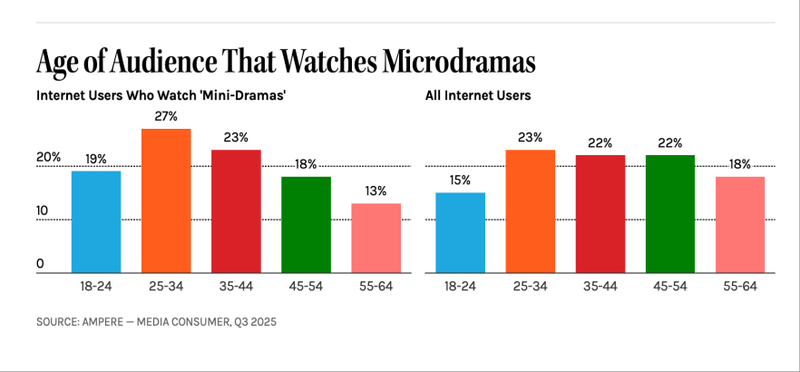
At the same time, the Asia-Pacific region has become the most dynamic market for micro-shortfall consumption.Among them, China, as a lead runner, continues to export content ecology overseas through platforms such as DramaBox and ReelShorts. With regard to interactive data, countries such as Thailand, Malaysia and the Philippines have the highest audience participation. It is worth noting that nearly half the views of the population aged 18 to 34 reflect the Z generation ‘ s pursuit of fast-paced, emotional and resonant narratives. The rise of micro-short dramas essentially responds to the demand of the generation for immediate emotional consumption and also promotes the platform ‘ s innovation in the rhythm and form of content creation.

It is no accident that YouTube has created a leading position in the micro-short play market. With huge user volumes, mature algorithms and strong content ecology, it has succeeded in transforming the stand-screen short play from a “social entertainment” to a new form of “stairscreen content consumption.” It’s not like TikTok, which relies mainly on algorithms and hot spots.YouTube Shorts has developed a sustainable viewing and creative cycle by connecting to the content of the main site:On the same platform, users are able to both watch short plays and track behind the scenes, interview actors and derivatives. This in-depth content structure makes the short play not just “brushed” but “traceed.”
This pattern provides a paradigm of transformation for the Chinese short play platform. While domestic platforms, such as ReelShort, are at the forefront of content production and narrative models, they generally face such problems as homogenization of content, low user retention and limited branding. By contrast, youtube’s success story is that it no longer views micro-features as mere “situations booms” but rather integrates them into a more complete ecological system, so that their content can extend and survive.
The next step in China’s micro-trip platform is the “content branding” and “ecological extension.”On the one hand, the platform can build an IP content matrix from short play clips, derivatives to thematic channels, drawing on YouTube’s tiered strategy, to enhance user viscosity; on the other hand, it can work with international platforms to export home-grown production systems and storyteller models abroad, allowing the “China Story” to find the path of globalization.
Now, YouTube is transforming the microtrip into a new generation of video IP incubators. Such a model, if absorbed by domestic platforms, would not only help to move away from the “fast-food content” label, but could also create an ongoing content brand on the international market. In the future, if China’s micro-fellows can move from “explosive-driven” to “ecological symbiotic”, they may be the navigators of global content.