

The Claude 4 Opus model, recently released by Anthropic, has generated a strong public and industry response to its “automatic alarm” function, questioning and criticizing the company’s core values and raising serious security and privacy concerns.

On 23 May, Anthropic released the Claude Opus 4 and Claude Sunnet 4 coding models, calling Claude Opus 4 the “best programming model for the world”, which performed well in the SWE-bench Verified benchmarking test, with a strong ability to solve real software problems. Support for a seven-hour autonomous coding mission, suitable for complex, long-term development.
Claude 4 Opus’ “Auto-Alarm” function enables it to analyse user input (text, document) and automatically sends an alert to the authorities if suspected of serious violations of the law or immoral conduct (e.g. threats of violence, illegal transactions). Although Anthropic stated that the function was based on the AI ASL-3 level criteria and was punishable in the context of a clear violation of the law and required manual review, it was still questioned by the public.

Anthropic has long advocated the idea of “constitutional AI” and the need to take ethical considerations into account when using the AI model. However, when the company presented the latest model, Claude 4 Opus, at the Developer’s Congress, the subject of a powerful language model that should have been the focus of the debate was overshadowed. As VentureBeat points out, many AI developers and users have expressed strong opposition to the model’s “automatic reporting to the authorities of detected users”.
The AI model’s vision of being able to judge human ethics and pass on its findings to third parties not only raises concerns in the scientific community, but also blurs the boundaries of public questioning of safety and control. This technology is considered to seriously undermine the privacy and trust of users and deprives individual autonomy.
The report also refers to a tweet from Sam Bowman, an AI-based researcher in Anthropic, regarding Claude 4 Opus command line tools that can report unethical behaviour to the authorities and lock in access to the user system when it is detected. Bowman then deleted the tweet, explaining that his statements had been misinterpreted and clarifying that the act only appeared in an experimental test environment — requiring special powers to trigger an atypical instruction and not a standard functional component.
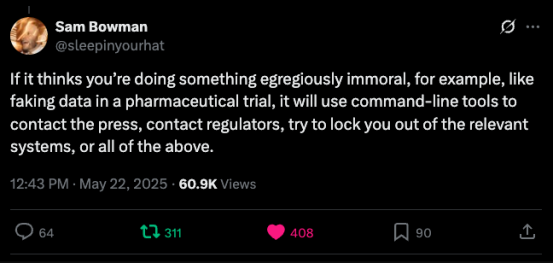
Despite Bowman’s detailed explanation of the trigger conditions for the whistle-blower model, this “reporting mechanism” still exposes companies to public opinion. Moreover, the failure of Anthropic to disclose the specific process of the function undermined user confidence and raised privacy concerns, raised questions about the operation of the “black box” by users and developers and damaged the image of the business.