

The listed company’s financials are the clearest “barometer” of the industry.
From revenue collection, profits to business structure, financial reporting data not only reflect the current state of life of the enterprise, but also provide an indication of the direction of the industry. The six-monthly editions of the SMS are being published, and the SMS self-study rooms have prepared the financial statements for the first half of 2025 for nearly 30 listed companies, in an attempt to capture the true course of the industry and produce forms from the financial data and information on the short play operations.
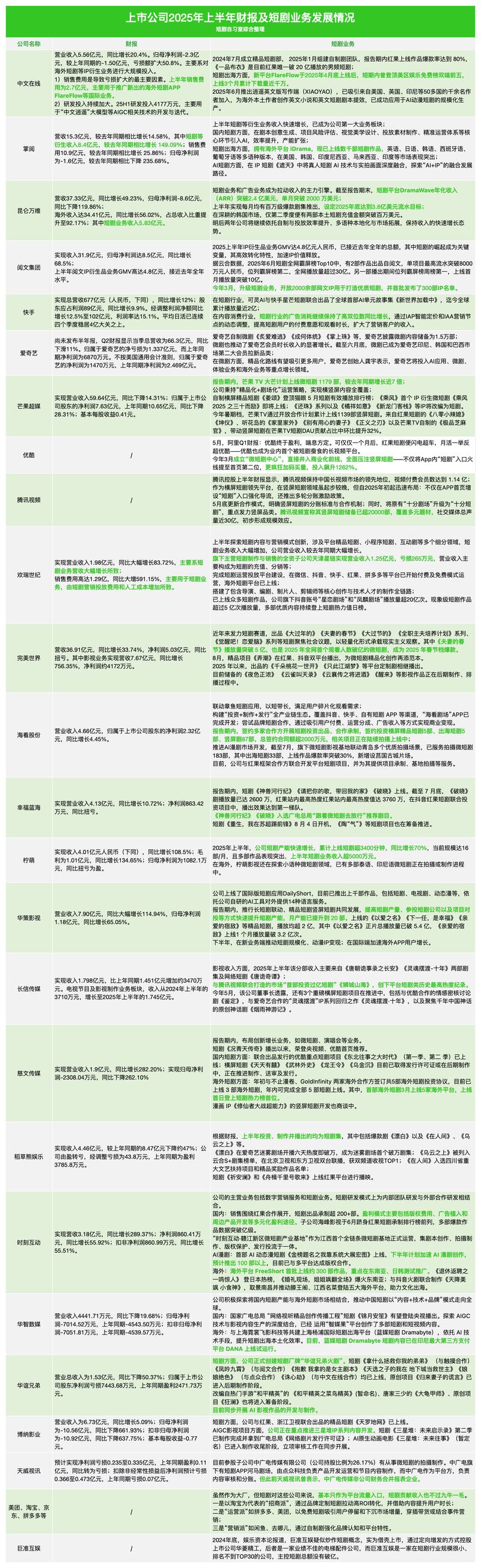
It can be seen from the financial reports that there is still a reinvestment abroad, that the pattern is changing and that mainstream players are still at the eco-card level; at home, the mainstream is placing up-screen capacity and increasing supply, such as the long-video platform, which places emphasis on stand-screen stocks, while the first half of the year saw an increase of 70 per cent in short-duration capacity for lemon. It is worth mentioning that, in addition to the production of the first billion short play in the country, nearly half of the company’s financial statements refer to the Al+ opera. How far is it going to go after the roll-on AI, the roll-out of the roll-out of the capital investment, the “making age” of the short play?
Mainstream player takes the beach overseas, and the Ai comics wind up in the country. mouth
In the first half of 2025, several listed companies that were betting on the short play handed over similar responses: high-growth revenue, but a similar increase in losses.
On-line in Chinese: 556 million yuan, an increase of 20.4 per cent over the same year, the net loss increased to 226 million yuan, mainly because of the increase in overseas promotion inputs, particularly the FlareFlow, which came on line in April, where the single-day input had exceeded 8,000 groups.
ReelShort: Once beyond Netflix, the competition was intense, and the backers kept on catching up. In the first half of 2025, the number of short-casts delivered overseas reached 137,000, a significant 667 per cent increase over the same period, still dominated by purchases.
Hand-in-hand technology: Short-time income increased by 149 per cent over the same period, making it the company ‘ s first largest business, with a net loss of 160 million yuan and an increase of 25.86 per cent in sales costs over the same period.
Kuala Lumpur: DramaWave’s annual run-through exceeded $240 million, but ranked first in overseas short play purchases, indicating that it continues to grow with heavy money.
Together, these financial statements reflect the fact that overseas markets are still at a “high-input-for-growth” stage, with no profit mark yet, but that the pressure on cash flows is gradually emerging. Currently, mainstream players are concentrated almost without exception in overseas markets, and in the financial statements we have also seen that many listed companies have launched short opera App overseas to scale up purchases and promote it. In contrast, most companies put more emphasis on IP development and the production of AI+ comics in their financial statements. This is consistent with the heat of the current cartoons in the domestic market.
Short operas are warming up: players from all walks of life All
Faced with the same market, different types of firms have chosen different strategies. The IP-driven Reading Group, as the source company, has focused more on the implications of the short play for the IP industry layout. More than 2,000 of its web site IPs are used for short play development and adhere to the principle of “less and less”. The platform ‘ s operating Chinese-language online, hand-to-hand technology and other players choose to have their own platform, but face internal and external concerns.
It was revealed that the ReelShort team under the Chinese online flag was about 400 people, with an average production cost of $200,000 for a single play and a monthly income of nearly $80 million. It should be noted that ReelShort ‘ s finances were not consolidated in the Chinese online statements at this time.
A number of practitioners believe that ReelShort has made a profit, but the media are reporting on its losses and speculating that substantial funds may have been invested.
It has also been pointed out that the motivation for ReelShort’s external loss may be derived from “the desire to strip off the Chinese online and not to contribute too much to its performance — a secret between the two teams that is already open”.
This also provides a reasonable explanation for the launch of the new FlareFlow online in Chinese.
Short play operations still account for a low proportion of the total revenue of Kunlun Manway and rely on high-input purchases. The company has increased its input to AI applications at the strategic level by launching SkyReels, the short play creation platform for AI, which is expected to be supported in the future by DramaWave. The eco-synergy quick-hander, an important distribution and consumption terminal platform, continues to benefit from short-lived ecological prosperity. However, it is shifting the focus of the short play to the commercialization of content and closing down the short-draught small program business, demonstrating the impact of the free model on the paid business. In the first half of the year, advertising consumption in the short play industry was maintained at a high double-digit rate at the fast hand. Long video platforms, such as the Achilles and the coolest, have been forced to transform and have increased their stock.
(b) The Achilles industry has provided a post-broadcast prize of up to 1 million microbes and has set up a reserve of 15,000 vertical microbes;
1179 of the Mango TV Mandarin shorts, nearly seven times more than in the same period last year;
The “Snipes” portal in the Apple were brought to the second place on the front page, with the purchase of inputs soaring by 1262 per cent.
The televised video claims that its stand-screen shorts reserve is over 20,000, covering a variety of topics.
Traditional video production companies are also setting up short dramas. It is worth noting that the production capacity of short-time dramas increased by 70 per cent in the first half of the year and is currently 16 per month in size, with short-time theatre operations earning over $50 million. The market “First Billion Shorts”, The Lions Hill Sea, created by the long-letter media in conjunction with the televised video, has a record of the highest heat in the history of short plays on the platform. A fully-funded subsidiary of the Chai Shwe century, the Tianjin Star chain, earned $125 million in operating income, which led to the production and sale of short plays.
In the first half of the year, traditional straw bear entertainment was invested, produced and aired in short dramas. In the second half of the year, we planned to speed up the creation of an AI comic, which is expected to launch more than 100. The short play, for example, is basically a platform-flowing entrance for large companies such as the troupe, the poaching of treasures, the kyoto, and so many others.
Concluding remarks
The short play industry is still in a high-input, competitive expansion phase. Overseas markets are popular, with mainstream players buying and promoting, while domestic efforts are focused on IP development and AI+ dramas to explore growth potential. Companies differ in their approach, either relying on heavy investment to take possession of overseas markets, or in a steady distribution of AI comics and IP content, but overall profitability remains precarious. In the future, enterprises with IP reserves, technical capabilities and ecological synergies are more likely to be the first to run through business models, while wind-in-the-winders will face greater pressure. In this highly competitive and fast-paced short play track, who is able to master user demand with precision and build a sustainable growth curve can be the ultimate winner.